
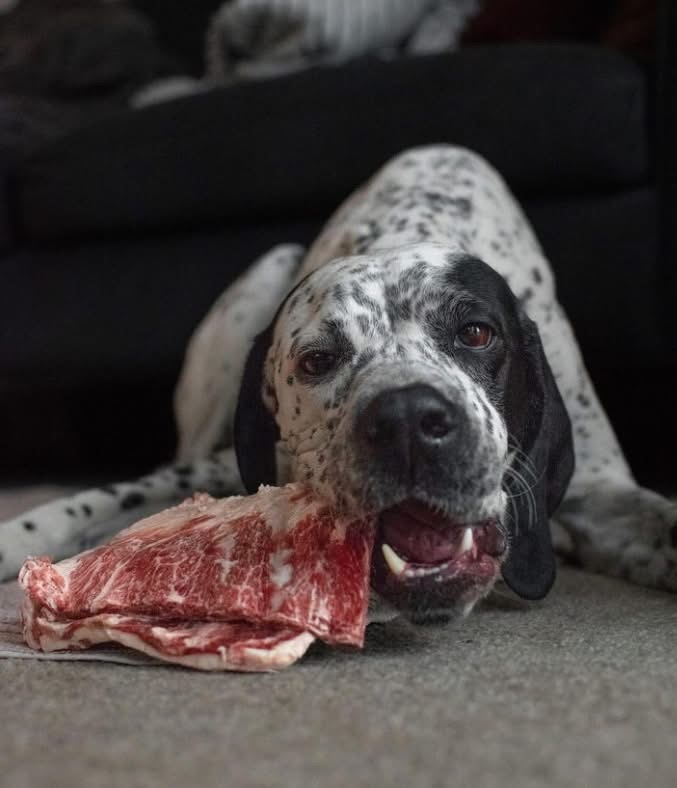
Raw meaty bones are rich in protein, fat, and minerals. They play a key role in raw feeding because they are highly nutritious and support overall health (1).
Bones Provide Calcium and Phosphorous
Calcium and phosphorus are essential minerals. They support strong bones, healthy teeth, and many vital body functions. For this reason, your pet must receive enough of both through their diet.
In addition, these minerals work together to build and maintain bone structure. Calcium supports blood clotting and nerve signalling. Meanwhile, phosphorus plays an important role in energy production and protein formation (2).
Most calcium and phosphorus in the body are stored in the bones (2,3). These minerals combine to form hydroxyapatite, the compound that gives bones their strength and hardness.
Pets fed a raw diet must get calcium from raw bone, bone meal, or a supplement (4). Feeding raw meat alone, even with vegetables, does not provide a balanced diet. Without a proper calcium source, the calcium-to-phosphorus ratio becomes inverted, which can be harmful to health. FEDIAF guidelines recommend a ratio between 1:1 and 2:1.
How Do Dogs and Cats Digest Bone?
Dogs and cats can digest raw bones effectively due to their strong stomach acid (5). This acidity activates digestive enzymes that break bone down into a grainy substance. This material acts like fibre in the digestive system.
Bones in Our Raw Meals
Commercial raw food contains minced bone, which improves digestibility. It is added in precise amounts to meet your pet’s calcium and phosphorus needs.
Mincing increases the bone’s surface area, allowing better nutrient absorption during digestion (4). It also removes the guesswork from balancing meals, as this has already been done for you.
It’s Important to Remember – Not All Bones Are Equal
While bones in premade raw meals are carefully selected, whole bones given as treats require more consideration. Therefore, some bones are better suited to your pet’s diet than others.
Generally, poultry bones are softer and more cartilaginous. As a result, they contain less calcium. In contrast, mammal bones such as beef and lamb are denser and richer in minerals. Typically, cattle bones contain the most calcium, followed by lamb, rabbit, duck, turkey, and chicken (6).
In addition, bone age also matters. As animals get older, their bones become harder and more difficult to digest. For this reason, our raw meals use bones from younger animals, which are softer and easier to process.
How Much Bone?
In our complete and balanced meals, bone content varies between proteins. This is because the goal is to achieve the correct calcium-to-phosphorus ratio in line with FEDIAF guidelines.
Different bones contain varying moisture and mineral levels. Therefore, the amount of bone required differs between proteins and recipes.
Never Feed Cooked Bones
Cooking makes bones brittle and sharp. Consequently, this increases the risk of choking, blockages, and internal injury. Always feed bones raw, as they are softer, safer, and easier to digest.
Lets Talk Poo
Typically, dogs fed a raw diet produce smaller, firmer stools. Bone and highly digestible ingredients contribute to this. Mild straining can be normal and may help with natural anal gland expression.
Excessive straining or hard, crumbly, or chalky stools may indicate too much bone. Reducing bone content can help improve stool quality.
So, Which Bones Can I Feed?
Choosing the right bone is important. When offering whole bones, observe how your pet eats. Encourage chewing and discourage gulping to reduce risk and support proper digestion.
See Our Helpful Guide: What Bones Can Dogs Eat, And How Do I Feed Them?
Lucy James, BSc (Hons) Bioveterinary Science
Looking to enhance your pet’s diet? Take a look at Cotswold RAW’s range of raw dog food and raw cat food, including raw meaty bones, dried treats, and puppy food.

- Craig, J. M. (2019) ‘Raw feeding in dogs and cat,’ Companion Animal, 24(11). Available at: https://www.magonlinelibrary.com/doi/full/10.12968/coan.2018.0068
- Stockman, J. et al. (2021) ‘Calcium, Phosphorus, and Vitamin D in Dogs and Cats Beyond the Bones,’ Veterinary Clinics of North America: Small Animal Practice, 51(3), 623-634. Available at: https://www.sciencedirect.com/science/article/pii/S0195561621000139?via%3Dihub
- Supriadi, S. et al. (2021) ‘Analysis of calcium levels in beef bones from kaledo waste,’ Journal of Physics: Conference Series, 1763. Available at: https://iopscience.iop.org/article/10.1088/1742-6596/1763/1/012061/pdf#:~:text=Beef%20bones%20have%20a%20fairly,%2C%20which%20is%20around%2085.84%25
- Thornton, K. C. (2000) ‘Feeding Raw Bones,’ Whole Dog Journal. Available at: https://www.whole-dog-journal.com/puppies/puppy_food/feeding-raw-bones/
- Butowski, C. F. et al. (2022) ‘The effects of raw-meat diets on the gastrointestinal microbiota of the cat and dog: a review,’ New Zealand Veterinary Journal, 70, 1-9. Available at: https://pubmed.ncbi.nlm.nih.gov/34463606/
Kober, N. et al. (2017) ‘Bones and gristle as a source of calcium in BARF-rations.’ Available at: https://www.researchgate.net/publication/323110816_Bones_and_gristle_as_a_source_of_calcium_in_BARF-rations#:~:text=As%20a%20source%20of%20calcium%20(Ca)%2C%20raw%20fleshy%20bones,bones%20as%20only%20Ca%20source1